 Press
Featured in The Whisky Magazine Japan
Celebrating the 10th anniversary of Tasmanian Whisky Week
Published 10|2026
Tasmanian Whisky Week celebrates its 10th anniversary
A nascent yet world-class whisky industry in a remote region. This 10th-anniversary event looks back on the growth of Tasmanian whisky.
Text by: Tis Kraberstein
This article was originally published in Japanese and has been translated into English. Quotes have been translated and may not match the speaker’s exact original wording.
Tasmania is an island located about 250km south of mainland Australia. In the Salamanca district, facing the harbor of the state capital Hobart, you'll find the multi-purpose convention venue "Princess Wharf No. 1".
The "Tasmanian Whisky Showcase" held at this venue features booths from over 40 companies, welcoming visitors for six hours. Amidst the crowd, Mark Teague spotted a familiar face.
The gentleman is a long-time whiskey enthusiast who has been a member of a local club since 1981. He wanders around the venue alone, chats with the staff, and buys several bottles to enjoy later. Teague felt respect and pride watching him choose his whiskey.
Teague had been contacted by that gentleman some time ago. Teague, who is dedicated to promoting Tasmanian whisky, receives a variety of inquiries. The gentleman's request was, "Could you recommend some events I should attend during Tasmanian Whisky Week in August?"
"When I receive inquiries like that, I always recommend the 'Tasmanian Whisky Showcase' on Saturdays. It's the highlight, after all. You can go with friends or family, or even by yourself. It's not just a chance to taste whisky, but also an opportunity to interact with the people who support the industry behind the scenes."
The warm, open atmosphere that permeates the event venue has deep roots. Bill and Lynn Lark, pioneers of modern Tasmanian whisky, have built a "culture of collaboration" here in Tasmania, passing on a spirit of mutual support within the growing whisky industry.
Christie Lark, one of the two daughters, currently runs the Kirara Distillery and serves as president of the Tasmanian Whisky & Spirits Association. The industry's welcoming culture for newcomers is a strong policy inherited from her parents' generation. Christie says that the culture of mutual support is still firmly rooted.
"Tasmanian Whisky Week is an extension of the spirit of mutual support. One of our main goals is to connect people through whisky. We have events perfect for everyone, including makers, enthusiasts, and beginners, and we are focused on creating a community where everyone can feel closer to the Tasmanian whisky industry."
Tasmanian whiskey is becoming more accessible.
Christie Lark has been a member of the event's organizing committee for the past eight years, witnessing the growth of Tasmanian Whisky Week firsthand. Only 12 distilleries participated in the inaugural "Showcase," and the event was run almost entirely by volunteers. The transformation leading up to this 10th edition has been dynamic.
Whisky Week spans nine days and features over 30 events across Tasmania. The highlight, the "Showcase," includes participation from more than 40 distilleries.
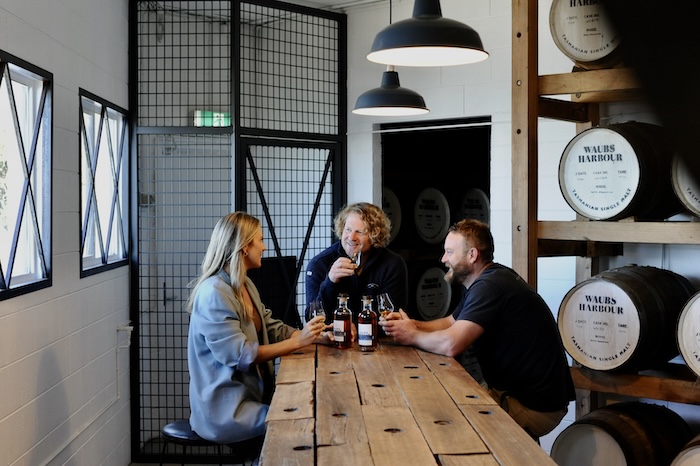
Bec Polmear (left), Tim Polmear (left), and Rob Polmear (left), who founded the Waubs Harbour Distillery. The main photo is also of the Waubs Harbour Distillery (©Andrew Wilson).
The annual "Meet the Maker" event, according to Christie, is like a "matchmaking session with a distiller." The "Sensory Pairing" of whiskey and perfume is a new initiative held for the first time this year. This is a collaboration between Sullivan's Cove and the Tasmanian perfume maker, The Raconteur.
The reason people keep coming back to the event is the sense of closeness they get from interacting with the producers. Visitors can meet and chat with distillery owners in the "showcase" and tour the distilleries and warehouses on chilly August nights. Andy Gaunt, CEO of Sullivan's Cove, says:
"It's a wonderful experience to hear directly from the people who made various decisions. Tasmania isn't that big, so you can visit many distilleries in a week."
Christie Lark similarly points out that "connections within the industry" are an opportunity during the event. Because the Tasmanian whisky industry is still young, visitors are welcomed like family.
"One of the great things about Tasmania is being able to talk with distillery founders and the pioneers of the whiskey industry."
At Waubs Harbour Distillery in the coastal town of Bicheno, you can really feel that Tasmanian character. Co-founder Beck Polmear explains:
"Rob, Tim, myself (Bec), and all the staff rarely get together in the same room. But you can meet us all at once at our event booth, so please come visit us."
Even as we grow up, we stay friends from the same town.
Mark Teague categorizes event attendees into two types. One type are regulars, who primarily come to check on changes since last year—that is, those interested in things like staff changes at distilleries and new products. The other type are first-time visitors, who are introduced to the diverse backgrounds and motivations of the various manufacturers and are surprised by the wide range of whiskies with unexpected characteristics.
This open nature of the industry can also be seen in the relationships between producers. Andy Gaunt says that even now that the industry has grown, their bonds have not been lost.
"When the number of producers increases this much, everyone tends to focus only on their own business. But that's not happening in Tasmania."
Sullivan's Cove invited rival producers Hellyers Road, Carrington Mill, Waubs Harbour, and Spring Bay to its premises, creating an opportunity for each company to showcase their respective whiskies. Gaunt explains the reason for this.
"The reputation of Tasmanian whisky overseas tends to be judged as a collection of regional brands. So, if one Tasmanian distillery gains recognition, it draws attention to other distilleries as well."
Bec Polmear goes on to say even more frankly:
"Without each other's existence, the Tasmanian whiskey industry could not exist. The more we cooperate with each other, the more we can all grow together."
That doesn't mean friendly competition disappears. At Mark Teague's "Teegue's Single Cask Odyssey" event, where tickets sold out in under an hour, each company displayed healthy competition. Distillers all gathered to serve "the best bottle they could offer that night." This is a coexistence of cooperation and rivalry.
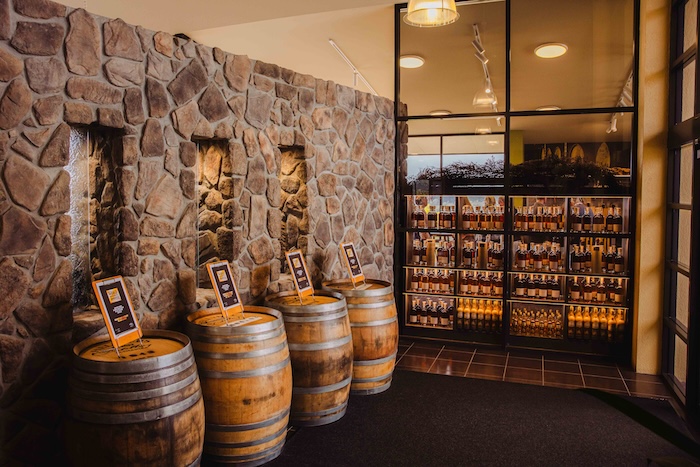
The cellar door of Hellyers Road Distillery, one of the leading producers. No matter where you visit their production facilities in Tasmania, you're enveloped in an intimate atmosphere.
In the 10 years since the event began, the industry has nearly quadrupled in size. There are now approximately 80 distilleries in Tasmania alone. In the same decade, Sullivan's Cove has achieved the unprecedented feat of winning the "World's Best Single Cask" award four times at the World Whisky Awards (WWA).
During Tasmanian Whisky Week, Sullivan's Cove Distillery opened a bottle of 18-year-old whisky aged in French oak Chardonnay casks. The World Whisky Awards trophy had just arrived from London.
Heather Tillotte, head of whisky production at Sullivan's Cove, reflects on the time she served special whiskies to guests.
"Looking around the venue, I saw that the entire whiskey community had gathered to celebrate with us. They were genuinely happy about the honor this bottle had brought to Tasmania. That moment itself symbolized everything about the event for me."
Even as the industry grows, Christie Lark didn't want to lose the intimacy of the events. With that in mind, he also focused on smaller gatherings at each distillery.
"Compared to the first year, the industry's growth is clear. Even though it has become a world-class whisky-producing region, what's wonderful about Tasmania is that you can still meet the industry's founders and see them thriving."
The "smallness" of the place is most palpable at the "showcase" venue. There, members of Warbs Harbour and three representatives from other distilleries were recommending whisky to visitors. Beckpolmire of Warbs Harbour explains:
"Putting aside the competitive relationship between rivals, I always choose moments like these to share the joy of a wonderful cup of coffee."
There's a saying in Tasmania: "When the tide comes in, all the boats float." Ten years have passed since Tasmanian Whisky Week began, and now many boats are docked in the harbor. And the harbor is still wide open to the open sea.
See original article published on The Whisky Magazine Japan here.
Shipping Australia wide only.
Standard Post delivery approximately 4-8 working days. $15 flat rate.
Express Post delivery is approximately 2-4 working days. $20 flat rate.
More details in our FAQ
We acknowledge Aboriginal people as the traditional owners of this Land and respect their culture and identity which has been bound up with the Land, Sea, Waterways and Sky for generations.
Receive first access to new releases
By submitting your details you are joining our email list and are legal age in your country.